
Your mouth is a microbiome.
Which sounds very scientific, but just imagine a whole community of tiny little living organisms hanging out in your mouth. Bacteria, fungi, and other microbes all living together on your teeth, tongue, gums and cheeks.
Some of them are good. Some… not so much.
The good ones help protect your mouth, they break down food and keep the not-so-good bacteria from completely taking over. And, keeping that little ecosystem balanced matters for WAY more than just avoiding bad breath and cavities.
If this is news to you, you’re not the first person to learn this as a fully grown adult, and thats fine, becasue now you know.
I never used to think about any of this. Toothpaste was toothpaste. You brush your teeth twice a day, go to the dentist, where they would still tell you to brush more and more. You then get your cavities filled and bam call it a day.
But let me tell you one thing about the internet, while it can be a huge distraction and lead you down some crazy rabbit holes. It’s also very educational. I started looking into what was actually in the toothpaste I was using, and what those ingredients were potentially doing to the bacteria in my mouth.
What’s in toothpaste, you might ask?
There’s a lot of unpronounceable and harmful ingredients in regular big-brand toothpastes.
For example
- SLS (Sodium Lauryl Sulfate): the foaming detergent. SLS can irritate oral tissue and can be an issue for people prone to canker sores. Even Crest acknowledges that.
- Artificial colours/pigments: some mainstream toothpastes literally contain ingredients like Red 30, Pigment Green 7 or Pigment Blue 15 just to change how the toothpaste looks. “why does my toothpaste need to be blue?“
- Titanium dioxide: used mainly to make toothpaste look bright white. Most big brand toothpastes contain it.
- Artificial sweeteners like sodium saccharin: added for taste rather than dental health. Commercial saccharin is synthetically manufactured, commonly starting with chemicals such as toluene or anthranilic acid and putting them through several chemical reactions.
- PEGs (polyethylene glycols): ingredients such as PEG-8 can be used to keep toothpaste moist and smooth. PEGs are generally made by reacting/polymerizing ethylene oxide, an industrial chemical usually produced from ethylene.
- Cocamidopropyl betaine: another surfactant/foaming ingredient used in some mainstream toothpastes. Some people avoid it because it can cause contact irritation or allergy in susceptible people, rather than because it’s broadly “toxic.”
Your mouth isn’t supposed to be sterile. A healthy oral microbiome depends on having a balanced community of microorganisms. When that balance gets disrupted, or becomes what researchers call dysbiosis, it has been associated with cavities, gum disease and other oral health problems.
And then there’s fluoride.
I personally started looking for a fluoride-free toothpaste before anything else.
I’m not going to sit here and tell you fluoride doesn’t work. It does have some evidence behind it for helping prevent cavities and strengthen enamel, and it is still widely recommended by dentists. I just personally wanted to try an approach that focused more on supporting the oral microbiome, rather than wiping it out.
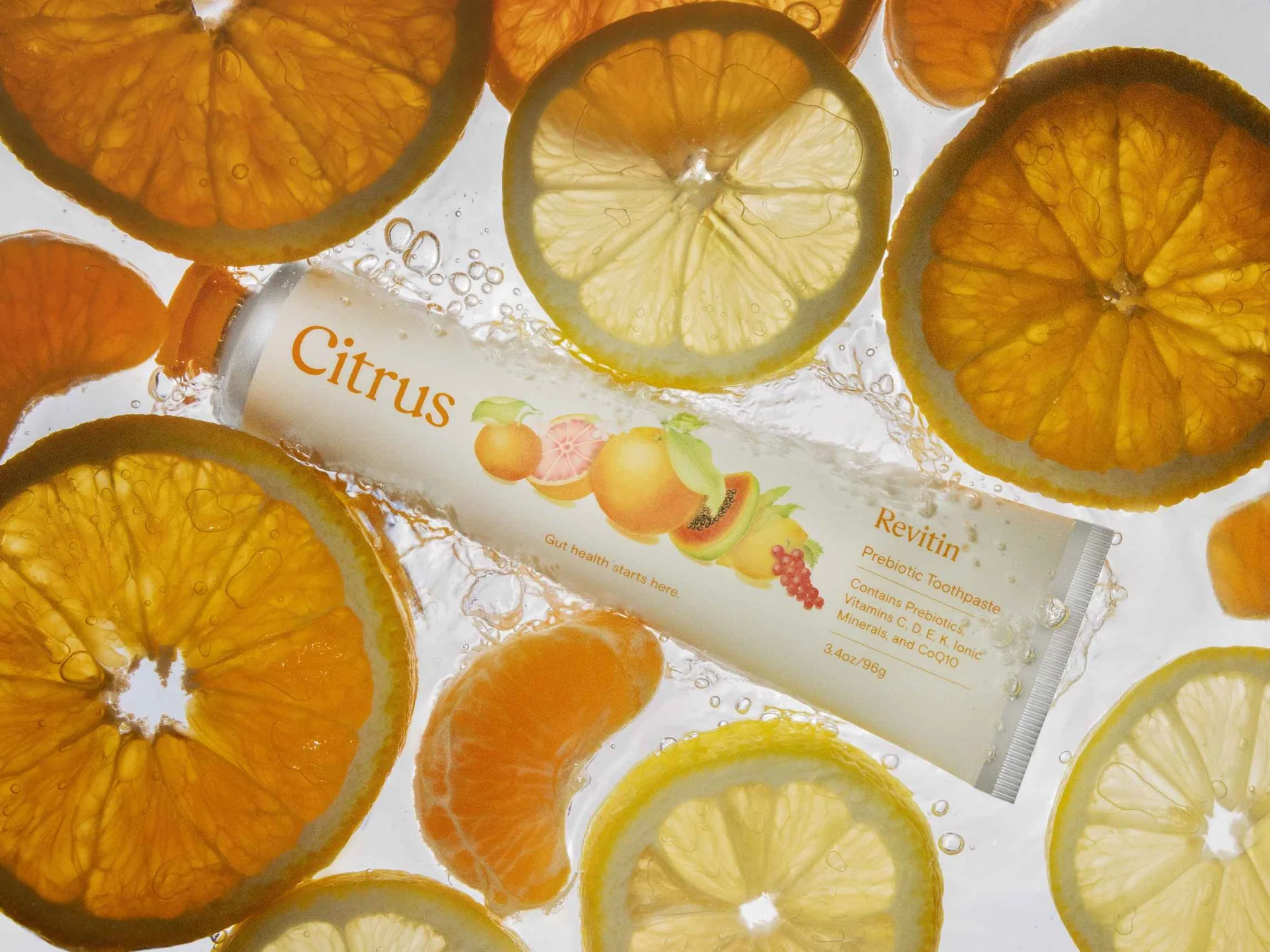
And that’s how I found Revitin.
Why I use Revitin (and no I’m not sponsored)
Revitin was created by dentist Dr. Gerry Curatola and is designed around the idea of supporting the oral microbiome rather than simply trying to kill bacteria.
It’s marketed as a prebiotic toothpaste and contains ingredients like calcium carbonate, dental silica, cranberry seed oil, seaweed, CoQ10 and vitamins C, D, E and K2. It’s also fluoride-free, SLS-free, dye-free, sugar-free and xylitol-free.
Do I think changing your toothpaste is magically going to transform your health? No.
Is it more expensive? Yes.
But after learning more about the oral microbiome, I liked the idea of using something designed to support that environment rather than focusing on wiping out every bacterium in my mouth.
Revitin also isn’t the only fluoride-free or SLS-free toothpaste out there, but it’s something I use every day, so it’s one of those things I’ve personally decided I’m okay spending a little more on, to support my health. I’ve been using it for over a year, and my gums are more healthy, my teeth sensitivity is gone, and I know i’m supporting my overall health.
And that’s really why I use it.
Know what you’re using. Do your own research. And then decide what makes sense for you.
Shop Revitin


Leave a Reply